Lost Highways: The Road Trip America Used to Take Before GPS Told It Where to Go
Photo: Joe Haupt from USA, CC BY-SA 2.0, via Wikimedia Commons
Pull out a map. An actual paper map, the kind that never folds back the way it opened. Spread it across the hood of a car somewhere in Missouri, trace a route with your finger, and argue about whether to cut south through the Ozarks or push straight through to Oklahoma. That argument — that moment of genuine uncertainty — was once the soul of the American road trip.
It's mostly gone now. And we barely noticed it leave.
The road trip is still a cherished American ritual. Millions of families load up every summer, point the car toward somewhere, and drive. But the experience of driving across this country has been so fundamentally transformed over the past fifty years that calling it the same thing requires a generous definition of continuity.
When the Road Had a Personality
Before the Interstate Highway System reshaped the country — a project that began in earnest in the late 1950s and continued through the 1970s — driving across America meant driving through America. US Route 66 didn't just connect Chicago to Los Angeles; it threaded through Joplin and Amarillo and Flagstaff, through towns that existed because the road existed, towns whose entire identity was built around the traveler passing through.
 Photo: Interstate Highway System, via lookaside.instagram.com
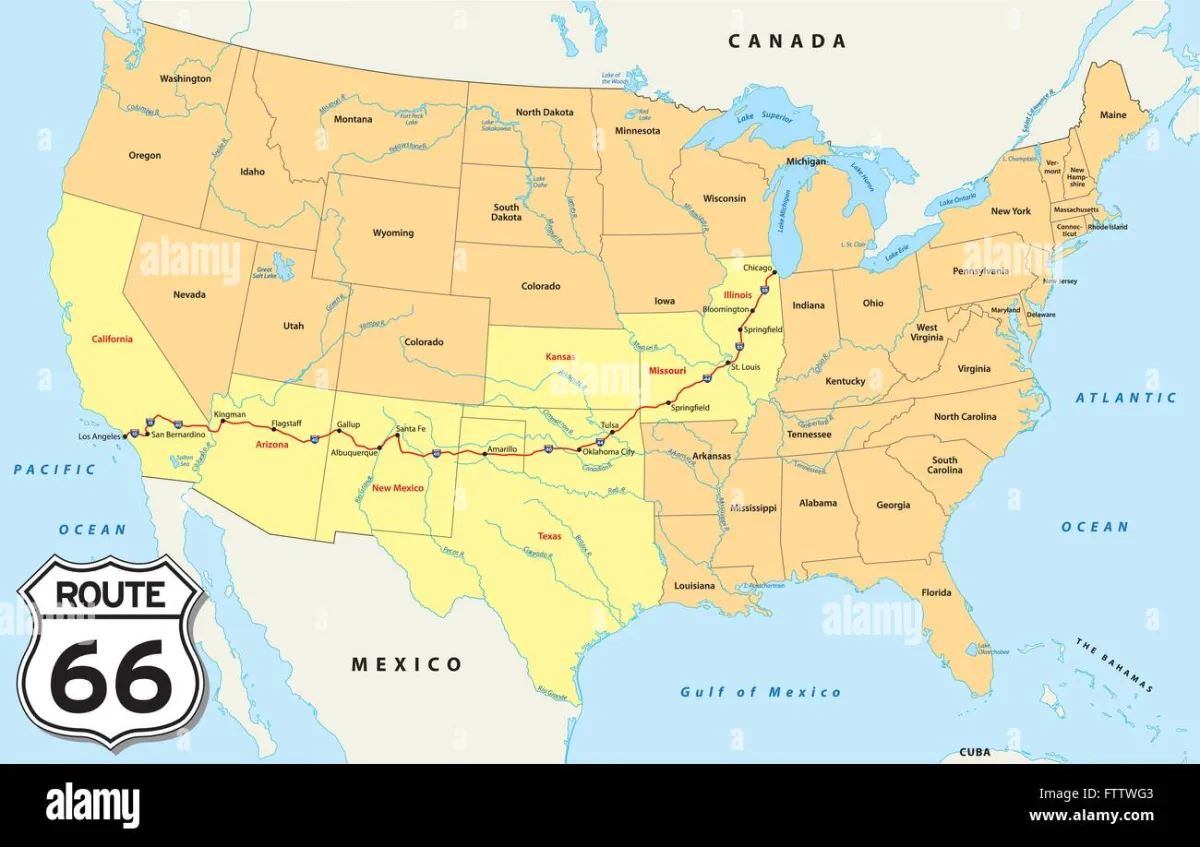 Photo: US Route 66, via c8.alamy.com
Every hundred miles brought a different regional accent, a different regional food, a different sense of place. You ate where locals ate, because that was what was there. You slept in motor courts — small, family-owned clusters of cabins that predated the branded motel chains — where the owner might sit on the porch and tell you which diner had the best pie. The pie was usually excellent.
The roadside itself was a form of entertainment. Hand-painted billboards for local attractions competed for attention in ways that were sometimes absurd and always memorable. The World's Largest Ball of Twine. Reptile gardens. Mystery spots. Roadside America was gloriously, unapologetically weird, and it was weird because individual people with individual ideas had built it, piece by piece, along the routes where travelers would pass.
The Interstate Bargain
The interstates were a genuine achievement. Faster, safer, more consistent — they made America more connected in ways that had real economic and social consequences. You could drive from New York to Los Angeles in three days instead of ten. Goods moved more efficiently. Families could cover more ground in the same vacation window.
But the bargain had a hidden cost. The interstates didn't pass through towns — they bypassed them. And towns that got bypassed tended to wither. The diner that had fed travelers for thirty years found itself a mile off the exit, invisible to anyone in a hurry. The motor court couldn't compete with the Holiday Inn that materialized at the interchange, the same in Tennessee as it was in Nevada.
By the 1980s, the American roadside had been largely standardized. Exit ramps offered the same rotating cast of fast food chains and gas station brands from coast to coast. You could drive a thousand miles and eat at the same restaurants you'd left behind at home. The regional weirdness that once defined road travel had been smoothed into something efficient and completely interchangeable.
Then Came the Phone
If the interstates erased the spontaneity of the route, smartphones finished the job on the experience itself. GPS navigation turned the driver into an instruction-follower. The passenger, once the co-pilot — responsible for the map, for watching for signs, for calling out turns — became a content consumer. Podcasts, playlists, audiobooks. The car became a mobile living room, and the landscape outside became wallpaper.
This isn't entirely a criticism. Long drives are more comfortable now. Children don't fight over window space while a parent navigates by memory through an unfamiliar city. You don't spend forty-five minutes lost in a suburb of Memphis because you missed an exit. These are real improvements.
But something was lost in the trade. Getting a little lost used to be how you found things. The diner you stumbled into because you took a wrong turn. The overlook nobody put in a guidebook. The town you'd never heard of that turned out to be exactly the kind of place you'd have driven past on the interstate without ever knowing existed.
The Serendipity That's Hard to Manufacture
What's striking about the road trips people remember most vividly — the ones that become stories told for decades — is that they almost always involve something unplanned. A detour that led somewhere extraordinary. A breakdown that forced an unexpected overnight stay in a town that turned out to be fascinating. A conversation with a stranger at a gas station that changed the direction of the trip entirely.
Serendipity, by definition, can't be optimized. But modern road trip culture tries anyway. Travel influencers post "hidden gem" routes that are then visited by thousands of followers, transforming the hidden gem into a crowded attraction. Apps recommend the "best" roadside stops with star ratings and photo galleries, removing the discovery and leaving only the confirmation.
Finding the Old Road
There are still travelers who seek out what remains of the old America. Route 66 preservationists have kept stretches of the original highway alive, complete with the diners and motor courts that somehow survived. The Blue Ridge Parkway still rewards drivers who resist the urge to check their arrival time. The backroads of Montana and the Texas Hill Country still offer the kind of driving that asks something of you.
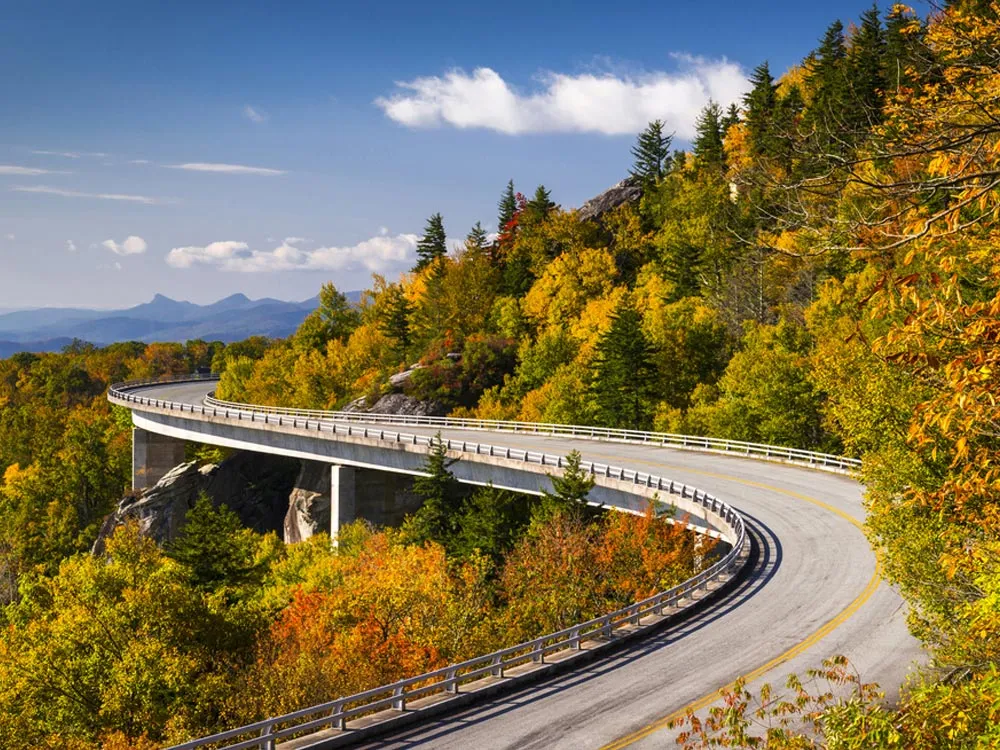 Photo: Blue Ridge Parkway, via images.mapsofworld.com
But finding that experience now requires deliberate effort — a conscious decision to slow down, to put the phone away, to take the road that the algorithm didn't recommend. It's become a choice rather than a default.
The highway used to be the destination. Now it's just the distance between two points on a screen. That's faster, certainly. But it's a different trip entirely.