The Red Pen Had the Final Word: When a Teacher's Correction Was the End of the Argument
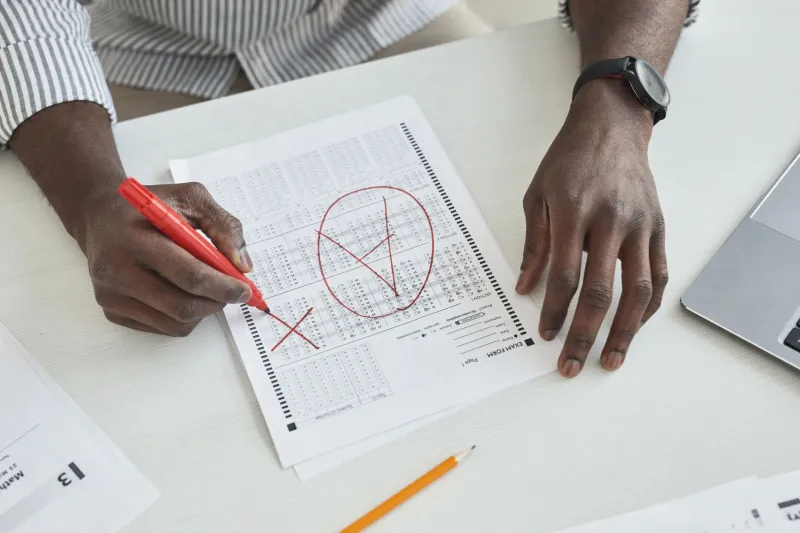
For most of American education history, the red mark on your paper was the verdict. You might not have liked it, but you accepted it — because the teacher knew, and you were still learning. That dynamic has shifted in ways that are more complicated than either side of the debate wants to admit.
Picture a seventh-grade classroom in 1987. A teacher writes a date on the board. A student thinks it's wrong. The student might whisper to a friend, or raise a hand and ask a careful question. But there's no way to verify the correction in real time, no device to consult, no search bar to settle it in thirty seconds. The teacher's answer stands — and if it was wrong, the student probably wouldn't find out until much later, if ever.
Now picture the same classroom today. The teacher writes the same date. Before the sentence is finished, three students have already confirmed or contradicted it on their phones. One of them raises a hand. The exchange that follows is nothing like what would have happened in 1987.
What the Red Pen Actually Represented
The teacher's red pen was never just about grammar or wrong answers. It was a symbol of a particular kind of authority — earned through years of study, credentialed by institutions, and trusted by parents who largely didn't question it. When your English teacher circled a comma splice or your history teacher marked a date incorrect, the implicit message was: I have spent time learning this so you don't have to learn it the hard way.
That relationship wasn't perfect. Teachers made mistakes. Some were confidently wrong. Some marked things incorrect for reasons that reflected bias more than fact. The unquestioned authority of the classroom had real costs, and plenty of students — particularly those whose experiences didn't match the textbook's version of events — paid them.
But there was also something genuinely useful inside that structure. It created a learning environment where students were expected to sit with a correction before reacting to it. You got your paper back, you saw the red mark, and you had to think about why it might be there. That cognitive pause — the moment of wait, maybe I was wrong — is where a lot of actual learning used to happen.
The Phone as Instant Referee
The smartphone didn't just give students access to information. It changed the emotional architecture of being corrected.
When a student can immediately verify a teacher's claim against three different websites, the correction becomes a negotiation rather than a lesson. This isn't always a bad thing — a teacher who's wrong should be correctable, and the days of unchallenged errors quietly calcifying into accepted fact weren't good for anyone. But the speed of verification has a side effect that doesn't get discussed enough: it can short-circuit the willingness to be wrong.
Learning to be wrong is a skill. It requires sitting in discomfort long enough to actually absorb the correction rather than immediately defending against it. The old classroom, with its red pen and its waiting period before the next class discussion, built in that discomfort whether students liked it or not. There was no escape hatch. You had to metabolize the mistake.
Today, the escape hatch is always open. And students — like most humans given an easier option — often take it.
What Students Actually Gained
It would be intellectually dishonest to frame this purely as a loss. The ability to fact-check in real time has genuine educational value that previous generations simply didn't have access to.
A student in 1975 who suspected their textbook was presenting a one-sided account of the civil rights movement had almost no recourse inside a standard classroom. The textbook was the textbook. The teacher taught from it. The test reflected it. That student might carry a nagging suspicion for years without ever having it confirmed or resolved.
The modern student can pull on that thread immediately. They can find primary sources, read competing accounts, and arrive at something closer to a fully dimensional understanding — all within the span of a single class period. That's not a trivial upgrade. That's a fundamental expansion of what learning can look like.
And teachers who embrace it rather than resist it often find that the classroom becomes more dynamic. When students bring a counter-source to the discussion, the lesson stops being a transmission of fixed knowledge and becomes something more like a live inquiry. That's closer to how knowledge actually works in the real world.
The Patience Problem
The harder question isn't about information access. It's about patience — specifically, the patience required to not know something for a while.
A lot of learning happens in the uncertainty before the answer arrives. When you work through a problem without immediately checking the solution, you build mental pathways that make the answer stick differently than it does when you simply look it up. Educators have a name for this: productive struggle. It's the cognitive effort of wrestling with a problem, and research consistently shows it produces deeper retention than passive reception of correct information.
The instant-verification reflex, however understandable, compresses that struggle into near-nothing. The student who Googles the answer before sitting with the question has technically acquired information. But they may have skipped the part of the process where the information becomes knowledge.
The Correction That Changed You
Ask most adults about a moment their thinking genuinely shifted, and a surprising number will describe a teacher who told them they were wrong about something they were confident about. Not in a cruel way — just firmly, with explanation, in a room where there was no way to immediately argue back. They had to think about it. They came back the next day and thought about it more. Eventually, they changed their mind.
That's not a story about authority being good. It's a story about what happens when you can't escape a correction — when the red pen marks the page and the page just sits there, waiting for you to make peace with it.
We gained a lot when we handed students the ability to verify the world in real time. What we may have lost is a little harder to Google.