The Man With the Glue Gun: When America Believed Everything Was Worth Saving
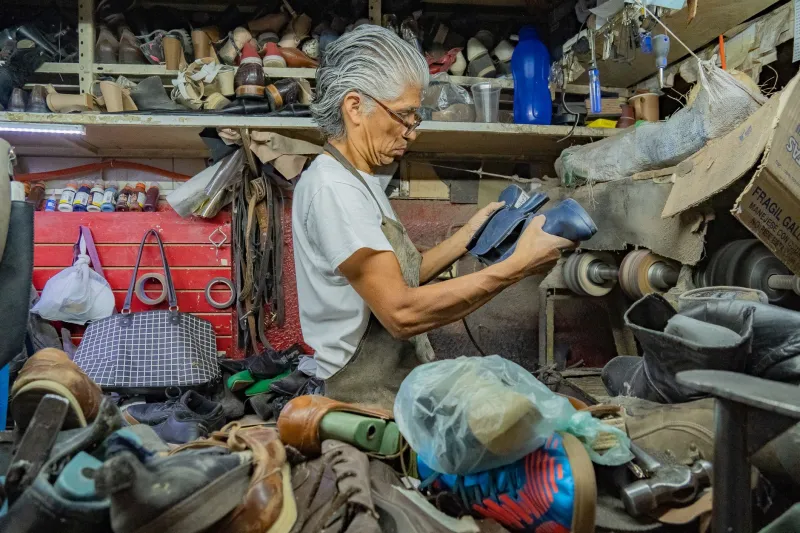
There was a shop on almost every Main Street in mid-century America that smelled like leather and machine oil. A small bell above the door. A man behind the counter who didn't ask whether you wanted to fix something — he just assumed you did. That was the cobbler. And next to him, maybe a block over, was the watch repairman with his magnifying loupe and his wall of clocks. Down the street, the tailor with pins in his collar and chalk marks on his fingers.
These weren't luxury services. They were just Tuesday.
For most of the 20th century, Americans had a fundamentally different relationship with the objects in their lives. Things were built to last, and when they stopped lasting, someone in your neighborhood knew how to make them last a little longer. The idea of throwing something away because it broke wasn't just wasteful — it was almost embarrassing.
Somewhere between then and now, that whole philosophy quietly disappeared.
The Neighborhood as a Repair Network
In the 1950s and 1960s, a typical American town was a self-sustaining ecosystem of small repair businesses. Cobblers resoled shoes that might be worn for a decade or more. Appliance repair shops fixed the family television — a major household investment that families expected to keep running for fifteen or twenty years. Tailors let out seams as families grew, took in hems as fashions changed, and patched elbows on sport coats that were already ten years old.
Watch repair was practically its own industry. A good watch was passed from father to son, and when the movement wore out, you took it to someone who could rebuild it piece by piece. The watch repairman wasn't a curiosity — he was as essential as the pharmacist.
These businesses weren't just economically practical. They were social institutions. The cobbler knew which kids were growing too fast for their shoes. The tailor knew who had lost weight after a health scare. Repair shops were places where you dropped things off and came back, which meant they were places where community happened.
When the Math Changed
The shift didn't happen overnight, but it accelerated dramatically in the 1980s and 1990s as manufacturing costs dropped and consumer electronics became disposable by design. When a new toaster costs $19.99 and a repair shop charges a minimum of $40 just to look at it, the economic logic of fixing things collapses entirely.
By the 2000s, planned obsolescence wasn't a conspiracy theory — it was a business model. Devices were engineered with components that couldn't be replaced, warranties that expired suspiciously close to the product's lifespan, and software updates that quietly slowed older models to a crawl. The message from manufacturers was clear: move on.
And Americans, largely, did.
The number of shoe repair shops in the United States has fallen by more than 70 percent since the 1980s. Independent appliance repair businesses have nearly vanished from most mid-sized cities. The watch repairman, once a fixture of every shopping district, now exists mainly in jewelry stores that also happen to offer the service as an afterthought.
What We Actually Lost
The obvious loss is economic. Americans now spend billions of dollars annually replacing items that could theoretically be repaired — electronics, clothing, small appliances, furniture. The average American household throws away 68 pounds of clothing per year, most of it still functional. The environmental math is staggering.
But the subtler loss is harder to quantify. When you repaired something, you had a relationship with it. A pair of shoes that had been resoled twice had a history. A coat that had been altered to fit your changing body was yours in a way that a fast-fashion replacement never could be. Repair created attachment. It extended the emotional life of objects alongside their physical life.
There was also something quietly educational about living in a world where things got fixed. Kids who watched their parents take a broken radio to the repair shop learned, implicitly, that things had interiors worth understanding — that a machine was a set of problems waiting to be solved, not a sealed black box to be discarded.
The Repair Revival That Stayed Niche
In recent years, there's been a genuine revival of interest in repair culture — iFixit tutorials, Right to Repair legislation, YouTube channels dedicated to restoring vintage appliances. Thrift stores have become fashionable. Tailors in major cities are busier than they've been in decades, largely driven by a younger generation that has discovered the appeal of well-made clothing worth maintaining.
But here's the uncomfortable truth: repair has become a hobby for the enthusiastic rather than a default behavior for everyone. It requires research, intentionality, and often a willingness to pay more upfront for something worth repairing in the first place. The casual, neighborhood-level repair infrastructure that once made fixing things the obvious choice simply doesn't exist anymore in most of America.
The man with the glue gun, the loupe, the chalk and pins — he's not coming back. At least not to every block.
A Different Kind of Relationship With Stuff
What's remarkable, looking back, isn't just that Americans repaired things more often. It's that they expected to. The assumption built into mid-century American life was that a good object deserved care, and that care was available and affordable. That expectation shaped how people bought things, how they used them, and how they felt about them.
Today, the assumption runs in the opposite direction. We buy expecting to replace. We use knowing we'll upgrade. And in between, we fill landfills with things that a previous generation would have considered salvageable without a second thought.
The cobbler's shop smelled like something being saved. It's worth asking what we traded it for.