The TV Turned Itself Off and So Did You: What We Gave Up When Entertainment Learned to Stay Awake
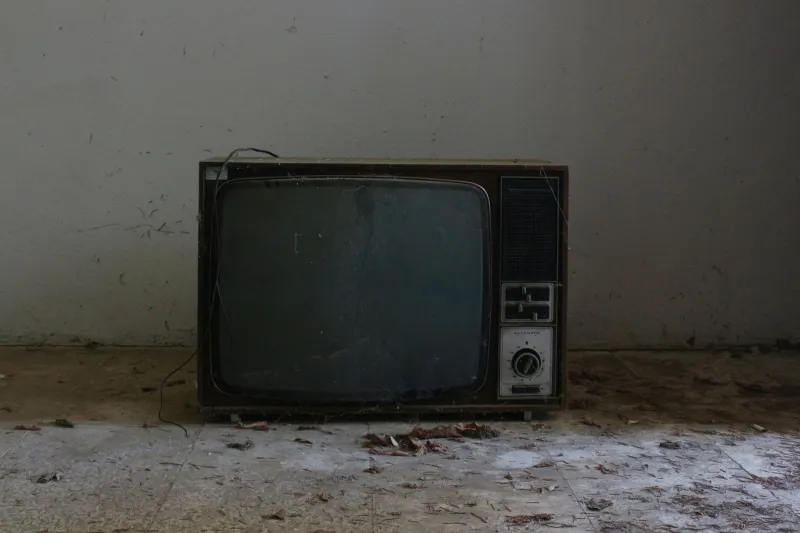
If you were a night owl in 1975, television had a message for you sometime around midnight: we're done here. The local station would run the national anthem, sometimes over footage of a flag or a fighter jet, and then the screen would dissolve into static — or, in later years, a color test pattern accompanied by a steady, indifferent tone.
That was it. The broadcast day was over. Whatever you were going to watch, you had already watched it.
For most Americans alive today under the age of forty, that concept is almost impossible to imagine.
When Television Had Office Hours
For the first few decades of American television, stations operated on schedules that would feel almost quaint today. Programming typically began in the morning and ended somewhere between midnight and 2 a.m., depending on the market and the day of the week. Sunday nights tended to wrap up earlier. Late-night programming was a specific genre — Johnny Carson, local news, maybe an old movie — not an infinite menu.
The structure wasn't arbitrary. It reflected the rhythms of daily life. People worked, came home, ate dinner, watched a few hours of television, and went to sleep. The broadcast schedule was designed around that pattern, and in a strange feedback loop, the pattern was reinforced by the schedule.
Viewers had to make decisions. If you wanted to watch something, you had to be in front of the television when it aired. If you missed it, it was gone — possibly forever. That scarcity made watching feel like an event. You didn't put on the TV as background noise. You sat down to watch something, and when that something ended, the evening wound down naturally.
The VCR Opened the Door
The first real disruption came with the VCR in the early 1980s. Suddenly, you could record a show and watch it later — a concept so novel that it spawned its own cultural anxiety about whether time-shifting television was somehow cheating. (The Supreme Court actually weighed in on this in 1984, ruling that home recording for personal use was legal.)
But even the VCR had limits. You had to remember to tape something. You had to have a blank cassette. The friction was real, and it kept consumption from spiraling completely out of control.
Cable television expanded the options through the 80s and 90s, and channels like HBO and CNN pushed toward round-the-clock broadcasting. By the mid-1990s, dead air had largely disappeared from major cable networks. But you still needed to find something worth watching, and that search had a ceiling.
Infinite Supply, Zero Stopping Points
Netflix launched its streaming service in 2007. Within a few years, the concept of not having anything to watch had become genuinely obsolete. Today, the average American has access to thousands of hours of content across a dozen or more platforms — more than any single person could watch in several lifetimes. And the services are designed, deliberately and carefully, to keep you watching.
Autoplay is the most obvious mechanism. When one episode ends, the next begins in ten seconds unless you actively intervene. The burden has been reversed: instead of choosing to watch more, you have to choose to stop. That's not an accident. It's an engineering decision made by people who understand that inertia is a powerful force.
The result is a phenomenon that now has its own name: revenge bedtime procrastination — the habit of staying up late consuming content as a way of reclaiming personal time from a busy day. Sleep researchers have documented it extensively. It's particularly common among people who feel they have little control over their daytime hours, and it's quietly wrecking the sleep patterns of a significant portion of the American adult population.
The Lost Art of the Ending
There's something psychologically meaningful about endings that our current media environment has essentially abolished. When a show concluded for the night, or when the broadcast day ended, there was a natural moment of completion. You had watched what there was to watch. The decision to stop wasn't yours to make — it was made for you, and that was fine.
That kind of externally imposed closure turns out to be genuinely useful for human beings, who are not especially good at self-regulating when pleasure is immediately available. The color test pattern at midnight was, in its own unsophisticated way, a public health intervention.
Family routines were shaped by it too. Bedtimes for kids were easier to enforce when the programming they cared about ended at a reasonable hour. Couples developed evening rituals that filled the time after the TV went dark. The absence of content created space for conversation, reading, or simply the kind of idle mental wandering that lets a brain decompress before sleep.
What Boredom Used to Do for Us
Perhaps the deepest loss is the disappearance of the condition that the endless feed was specifically designed to prevent: boredom. Not the anxious, restless boredom of having nothing to do, but the quieter kind — the mild, low-stakes experience of sitting with your own thoughts because the alternative wasn't available.
Researchers who study creativity and cognitive rest have argued for years that this kind of unstructured mental downtime is essential for processing experience, generating ideas, and consolidating memory. The brain doesn't just rest when it's idle — it does important work. But it can only do that work when it isn't being fed a continuous stream of input.
The test pattern at midnight wasn't just telling you to go to bed. It was telling you that you'd had enough — that the day was complete, that the screen had given you what it had to give, and that whatever came next would have to come from somewhere inside yourself.
That signal is gone now. And we're all a little worse at hearing it.