Wrong Turn, Right Place: What We Surrendered When We Stopped Getting Lost
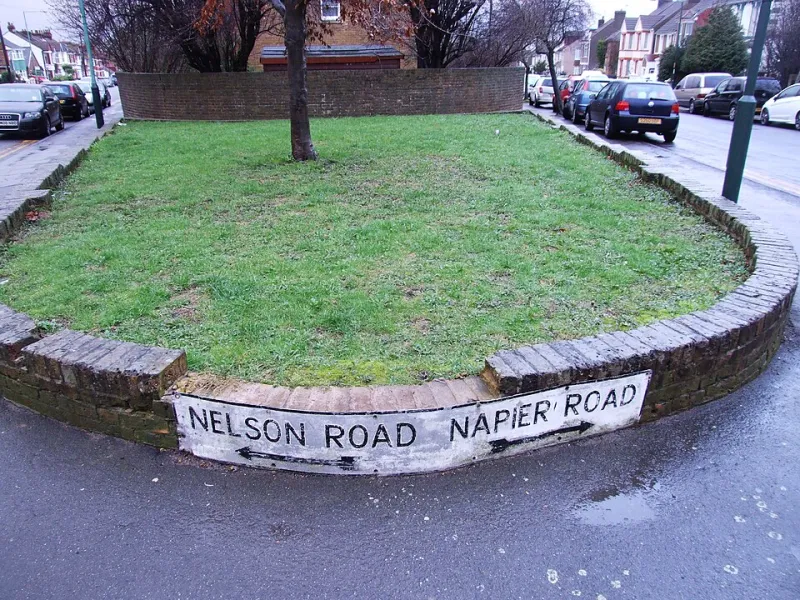
Photo: Chris Whippet , CC BY-SA 2.0, via Wikimedia Commons
There's a diner in a small town in eastern Tennessee that a family from Cincinnati found by accident in the summer of 1987. They'd taken a wrong exit off I-40, argued briefly about whether to turn around, and decided to push on. The pie was remarkable. They went back for three consecutive summers. The owner remembered their names by the second visit.
That diner almost certainly still exists. But the family would never find it today — because today, they'd never take the wrong exit. The phone would have corrected the mistake before it became a memory.
The Art of Going Somewhere
Before turn-by-turn navigation became universal — roughly before 2007, when the iPhone launched and Google Maps became something you carried in your pocket — getting somewhere you'd never been required actual preparation.
You consulted a road atlas. If you were driving across multiple states, you might trace the route the night before with a highlighter. Gas stations sold fold-out maps of individual states, and the ability to refold one correctly was a minor life skill that most adults had and almost no one under 30 currently possesses. AAA members could request a TripTik — a custom-printed, spiral-bound booklet of maps for a specific route, prepared by a human being at a local office.
All of this created a relationship with geography that was fundamentally different from what we have now. You understood, roughly, where you were in relation to where you were going. You knew which direction was north. You had a mental model of the route — not just the next instruction, but the whole arc of the journey.
And when you got it wrong, which happened, you figured it out. You stopped at a gas station and asked. You unfolded the map on the hood of the car. You made a decision based on incomplete information and your own best judgment. Sometimes that decision led somewhere unexpected. Sometimes unexpected was better than planned.
The GPS Bargain
The navigation technology that became mainstream in the early 2000s — first as dedicated Garmin and TomTom devices, then absorbed entirely into smartphones — was, by any practical measure, a staggering improvement. Fewer wrong turns. Less time lost. Road trips became dramatically less stressful, particularly in unfamiliar cities. The cognitive load of navigating while driving dropped considerably, which almost certainly reduced accidents.
The efficiency gains were real. Nobody who has ever tried to navigate downtown Boston using a paper map is going to argue that GPS made things worse in purely logistical terms.
But efficiency isn't the whole story.
What GPS replaced wasn't just the inconvenience of getting lost. It replaced the experience of navigation — the engagement with space, distance, and decision-making that used to be an active part of travel. When your phone tells you to turn right in 400 feet, you don't need to know where you are. You don't need to understand the layout of the city. You don't need to develop any mental map at all. You just follow instructions.
Researchers have actually studied this. A 2020 study from University College London found that people who regularly use GPS navigation show reduced activity in the hippocampus — the part of the brain associated with spatial memory and navigation — compared to people who navigate using their own judgment. London taxi drivers, famously required to memorize the city's entire street network, have measurably larger hippocampal regions. The brain, it turns out, develops the capacity it's asked to use.
When we stop asking it to navigate, it stops being very good at navigating.
Discovery as a Byproduct of Uncertainty
There's a specific kind of American travel experience that GPS has made nearly obsolete: the accidental find.
The roadside attraction you stumbled onto because you pulled off to check the map. The small-town diner that appeared at exactly the right moment on a long stretch of highway. The scenic overlook that wasn't in any guidebook but was visible from the road you took because the interstate was backed up and you improvised.
Travel writers have long understood that the best stories come from the unplanned moments. The detour that became the destination. The place you'd never have visited if everything had gone according to schedule.
GPS optimizes against exactly those moments. It finds the fastest route, avoids the delays, and keeps you on track. It is, in the most literal sense, a tool for eliminating uncertainty. And uncertainty, for all its frustration, was the engine of discovery.
Road trip culture in America was built on a particular kind of openness — the sense that the country was large and surprising and that you might encounter something genuinely unexpected around the next bend. John Steinbeck felt it. Jack Kerouac romanticized it. Millions of ordinary families experienced a quiet version of it every summer, pulling out of the driveway with a general direction and a rough plan and a willingness to see what happened.
That openness hasn't entirely disappeared. But it requires a deliberate act of resistance now. You have to choose to put the phone down. You have to decide, consciously, to not know exactly where you are. That used to be the default. Now it's a preference you have to actively select.
The Road Ahead
None of this is an argument for going back. GPS saves time, reduces stress, and has almost certainly prevented countless accidents. For anyone with a medical emergency, a tight deadline, or a genuine inability to navigate by instinct, the technology is nothing short of transformative.
But it's worth acknowledging what the bargain cost.
We traded spatial literacy for convenience. We traded serendipity for efficiency. We traded the satisfaction of figuring it out ourselves for the comfort of being told exactly what to do, one turn at a time.
The Tennessee diner is still there. The pie is probably still good. The family from Cincinnati just needs to put the phone in the glove compartment and take a wrong exit on purpose.
Some things are still worth getting lost for.