The Lucky Accident of Learning: What Disappeared When Search Got Too Smart
Somewhere in a public library in the mid-1980s, a teenager went looking for a book about the Civil War and accidentally spent two hours reading about the construction of the transcontinental railroad instead. She didn't find what she came for. She found something better — a thread she hadn't known existed, pulling her toward a subject that would shape her career as a historian.
That kind of accident used to be built into the architecture of knowledge. Today, it's almost impossible to have.
The Card Catalog as Teacher
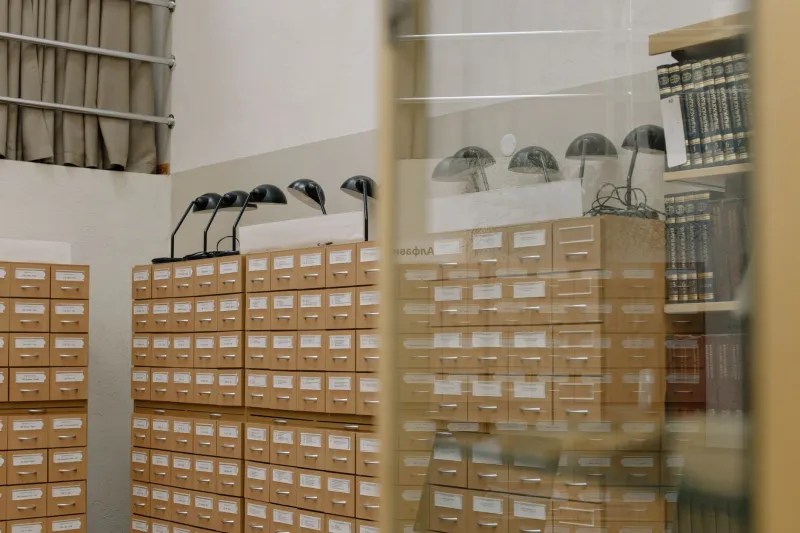
Before the internet, before digital databases, before the search bar, there was the card catalog. For generations of Americans, it was the primary interface between a question and an answer — a long wooden cabinet filled with small drawers, each stuffed with index cards organized by author, title, and subject.
Using it was a skill. You had to know how the Library of Congress classified subjects, which meant you had to think carefully about the category your question actually belonged to. Was it history? Social science? Political science? The act of figuring out where to look was itself an education.
And then came the browsing. Once you located your general section, you walked the stacks. Books sat beside other books on related topics, organized by a logic that rewarded the curious. You'd pull one title, scan the shelf, notice something adjacent, and follow the thread. The physical arrangement of knowledge was a kind of map, and wandering it was how you learned where things connected.
Librarians were the human layer on top of that system. They knew the catalog the way a seasoned local knows back roads — not just what was there, but how it related to everything else. A good reference librarian didn't just point you to a book; she pointed you to three books you hadn't thought to ask about, and explained why they'd be useful. That was a form of intelligence that no index card could replicate.
When Efficiency Replaced Exploration
The internet didn't kill serendipitous discovery all at once. Early search engines were actually pretty bad at giving you exactly what you wanted, which meant you often ended up somewhere unexpected. Early web browsing had some of the same wandering quality as the library stacks — you followed links, stumbled onto pages, got lost in interesting ways.
But the smarter search got, the narrower the corridor became.
Google's core innovation was precision. Its PageRank algorithm was designed to surface the most authoritative, most relevant result for your exact query as quickly as possible. That was genuinely useful. But precision came at a cost: the further the algorithm moved from what you asked for, the more it felt like a failure rather than a discovery.
Today, the system is so finely tuned to your stated intent — and your browsing history, location, previous searches, and behavioral data — that genuine surprise has become rare. Search for "best Italian restaurants," and you'll get a list optimized for your zip code and past dining habits. You won't accidentally stumble into an article about the history of Italian immigration in your city that makes you think differently about the neighborhood you live in.
The algorithm gives you what it thinks you want. It's very good at that. What it doesn't do is give you what you didn't know you needed.
The Serendipity Gap
Researchers who study creativity and learning have a name for the phenomenon the card catalog encouraged: productive serendipity. It's the discovery made by accident that turns out to matter more than the discovery you were seeking. Scientists have credited chance encounters in libraries with research breakthroughs. Writers have built entire careers on subjects they stumbled into while looking for something else.
The conditions for that kind of accident are increasingly engineered out of our information systems. Recommendation algorithms — on Google, on Amazon, on Spotify, on Netflix — are explicitly designed to reduce friction between you and what you already like. They are optimization machines, and what they optimize for is engagement and satisfaction with the expected.
What they're not optimizing for is the experience of being genuinely surprised by something you didn't know you cared about.
There's also a subtler loss. The card catalog forced you to articulate your question clearly enough to navigate a physical system. That process of articulation — figuring out what you were actually asking — often clarified your thinking before you'd read a single page. Today, you can type a vague, half-formed query and receive a usable answer in seconds. The thinking that used to happen before the search now often doesn't happen at all.
The Filter Bubble Nobody Asked For
The consequences extend beyond individual learning. When everyone's search results are personalized, people in the same community can look up the same topic and receive fundamentally different information landscapes. The common reference points that shared institutions like libraries provided — the same books on the same shelves, available to everyone — have been replaced by individualized information environments.
A library didn't know who you were when you walked in. It gave everyone access to the same catalog, the same stacks, the same serendipitous possibilities. The democratic quality of that access was a feature, not a limitation.
What Efficiency Actually Cost
None of this is to say that search engines aren't useful — they're extraordinary tools for finding known information quickly. But useful and complete aren't the same thing. The card catalog wasn't efficient. It was slow, sometimes frustrating, and required patience and effort. It also produced a particular kind of knowledge: deep, contextual, full of unexpected connections.
The teenager who went looking for Civil War books and found herself in the railroad section wasn't wasting time. She was doing exactly what learning is supposed to do — following curiosity wherever it leads, without a system deciding in advance where that should be.
We built smarter search and lost the lucky accident. Whether that trade was worth it depends on what you think knowledge is actually for.