One Lamp, One Subject, One Hour: What Happened to the American Kid Who Actually Studied
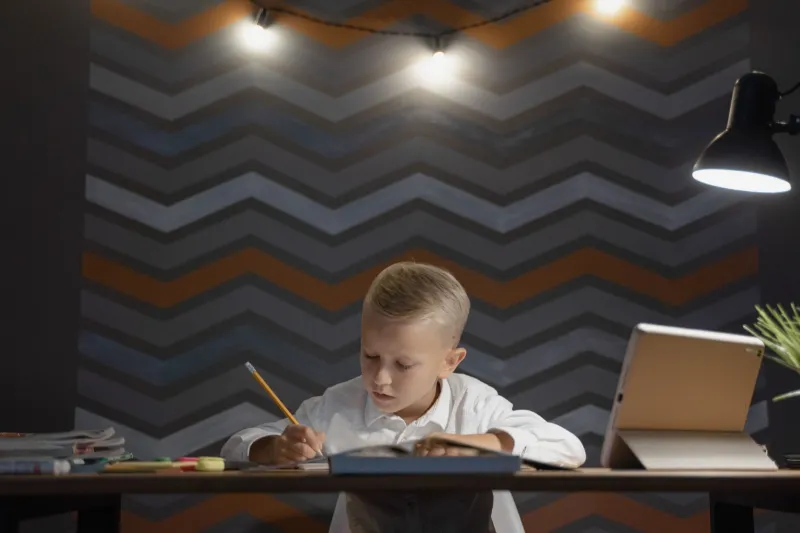
Picture a kitchen table in 1974. A ten-year-old sits down after dinner with a math worksheet and a sharpened pencil. The television is off. The house is reasonably quiet. Mom is doing dishes nearby. There's nothing else competing for attention — no device buzzing in a pocket, no second screen glowing from the corner, no notification asking whether homework can wait just a second.
The kid does the math. Makes some mistakes. Erases them. Does it again. Finishes. Gets up.
That's it. That was studying.
It sounds almost quaint now, but there's something in that picture that deserves a closer look — because what that child was doing, without knowing it, was practicing one of the most important cognitive skills a person can develop: sustained, undivided attention.
The Desk Was the Point
For most of the twentieth century, the physical environment of homework was remarkably consistent across American households. A dedicated spot — kitchen table, bedroom desk, dining room corner — a lamp, and the materials for one subject at a time. The constraints weren't pedagogical choices. They were just the reality of how homes worked before personal technology.
But those constraints turned out to be quietly valuable. Neuroscientists now understand that the brain learns most effectively in conditions of focused, single-task engagement. When attention is undivided, the hippocampus — the brain's memory consolidation center — encodes information more deeply. Repetition without distraction strengthens neural pathways in ways that fragmented, interrupted learning simply doesn't replicate.
In other words, the boring kitchen table with the one lamp was doing something important. It wasn't just where homework happened. It was where concentration was practiced, every single night, as a matter of routine.
What Changed, and How Fast
The shift didn't arrive all at once. It started with cable television in the bedroom — a luxury in the eighties that became standard by the nineties. Then came desktop computers, then laptops, then smartphones. Each device brought new capabilities and new distractions, and each one made it harder to argue that homework required a quiet room and nothing else.
By the early 2010s, the average American teenager was managing homework across multiple platforms simultaneously. A 2015 study from the University of California, Irvine found that it takes an average of twenty-three minutes to fully regain focus after an interruption. For a student fielding text messages, social media notifications, and YouTube suggestions while trying to write an essay, that recovery time compounds across an entire homework session — meaning deep concentration may never actually be achieved at all.
A 2019 report from Common Sense Media found that 50 percent of teens felt addicted to their mobile devices, and 72 percent felt compelled to respond to texts and notifications immediately — including during homework. The technology didn't just enter the study environment. It restructured it entirely.
The Myth of Multitasking
Somewhere along the way, the idea took hold that today's students are better at multitasking than previous generations — that growing up with multiple screens has produced a kind of cognitive flexibility that older learners don't have. It's an appealing story. It also isn't supported by the research.
Studies from Stanford, MIT, and the University of Michigan have consistently shown that heavy media multitaskers perform worse on tasks requiring sustained focus than light multitaskers. The brain doesn't actually do two things at once — it rapidly switches between them, and each switch carries a cognitive cost. What looks like multitasking is actually a series of interruptions, each one drawing down the attention budget a little more.
The students sitting at kitchen tables in the 1970s weren't smarter. But they were practicing something that multitasking actively erodes: the ability to stay with a hard problem long enough to actually solve it.
Technology Promised to Help
It's worth being fair here. Educational technology has delivered real benefits. Students today have access to research tools, instructional videos, collaborative platforms, and adaptive learning software that would have seemed miraculous to a kid with a pencil and a worksheet. The breadth of available information is genuinely extraordinary.
But access to information and the ability to learn deeply from it are two different things. A student who can Google any answer in thirty seconds may never develop the tolerance for uncertainty that comes from sitting with a problem and working through it slowly. A student who watches a YouTube explainer instead of reading a chapter may absorb the surface of a concept without building the structural understanding that comes from wrestling with dense text.
The tools are better. The conditions for using them well may have gotten harder.
What the Quiet Room Was Actually Teaching
There's a concept in psychology called effortful retrieval — the idea that struggling to recall information, rather than having it immediately available, actually strengthens memory and comprehension. Flashcards work better than re-reading notes. Closing the book and trying to recall a passage works better than highlighting it. Difficulty, in learning, is often the point.
The old homework environment was full of effortful retrieval by default. You couldn't look up the answer in three seconds. You had to think. You had to hold the question in your head long enough for your brain to work on it. That friction was frustrating, but it was doing something.
Today's students aren't less capable. But many of them are growing up without regular practice in the skill that the kitchen table quietly demanded every evening: staying in one place, with one problem, until it's done.
The lamp didn't seem like much. It turns out it was doing a lot of the work.