The Note That Took Three Days to Arrive and Why It Meant Everything
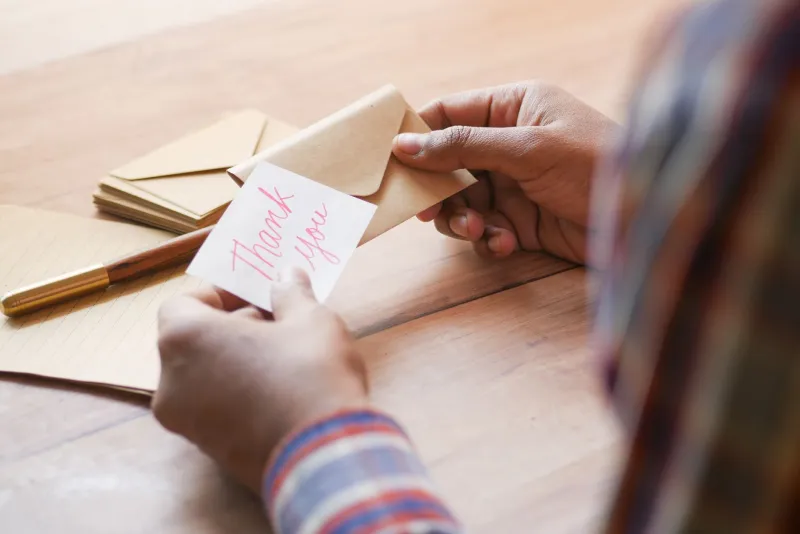
Your grandmother kept them in a shoebox. Birthday cards, sympathy notes, thank-you letters written in ink on cream-colored stationery — small rectangles of paper that someone had taken the trouble to fold, seal, address, stamp, and mail. The postmark might read 1987 or 1962. It didn't matter. She kept them because they meant something.
Nobody keeps a text message in a shoebox.
The handwritten thank-you note is not entirely extinct, but it has become so rare that receiving one now feels almost startling — like bumping into a form of courtesy you'd forgotten existed. A generation ago, sending one wasn't optional. It was simply what you did. The question worth sitting with is: what changed, and did we lose something real when gratitude became frictionless?
What the Note Actually Required
Let's be specific about what writing a thank-you note actually cost a person in, say, 1985.
First, you needed stationery or a card — which meant either having it on hand or going to buy it. You needed a pen that worked. You sat down and thought about what to say, because a blank card is an invitation to be specific, and being specific requires remembering and reflecting. You wrote it out. If you made a mistake, you either lived with it or started over on a fresh card. You addressed the envelope — which required knowing someone's mailing address, a piece of information that demanded its own small effort to maintain. You found a stamp. You walked to the mailbox or the post office.
From start to finish, a thank-you note might take twenty minutes and cost a dollar or two. That doesn't sound like much. But multiplied by genuine intention, it added up to something the recipient could feel. The note, when it arrived, was physical proof that someone had carved time out of their day specifically to acknowledge you.
That's not nothing. In fact, psychologists would argue it's quite a lot.
The Psychology of Effort-Based Gratitude
Research in social psychology has consistently found that the perceived value of a gift or gesture is closely linked to the effort invested in it. This principle, sometimes called the labor illusion, applies not just to gifts but to expressions of appreciation. When someone goes out of their way to thank you — especially in a way that requires visible effort — the emotional impact is meaningfully greater than a low-effort acknowledgment, even if the words are similar.
A 2018 study published in Psychological Science found that people dramatically underestimate how much a handwritten note means to the person receiving it. Senders consistently predicted that their notes would feel awkward or unnecessary. Recipients consistently reported feeling genuinely moved. The effort gap — the space between what it cost the sender and what it meant to the recipient — was much wider than either party expected.
The old culture of thank-you notes was, in retrospect, a system for reliably generating that gap. It built effort into the expression of gratitude as a matter of social expectation.
How It Unraveled
The decline didn't happen because people stopped feeling grateful. It happened because the infrastructure of gratitude changed.
Email arrived first, and with it the idea that a message could be sent instantly without paper or postage. Then came texting, which compressed communication further — full sentences gave way to fragments, fragments to abbreviations, abbreviations to emoji. Each compression was faster and more convenient than the last. And convenience, once offered, is almost impossible to refuse.
Social media added another layer. A public post thanking someone — visible to hundreds of followers, garnished with likes — started to feel like a more significant gesture than a private note, even though it required almost no effort and served partly as personal branding. Gratitude went from being something expressed to a person to something performed for an audience.
The group text finished off what was left. After a birthday dinner or a wedding shower, a single message sent to fifteen people simultaneously now stands in for fifteen individual expressions of thanks. It's efficient. It's also impersonal in a way that everyone senses but few people name.
The Stamp Was a Small Act of Respect
Here's what the stamp represented: the acknowledgment that someone else's time and effort were worth a small, concrete expenditure of your own. The note didn't have to be eloquent. It didn't have to be long. But it had to be sent — which meant it had to be written — which meant it had to be thought about.
That chain of small obligations was the whole point. Courtesy, at its core, is the practice of treating other people's contributions as worthy of your inconvenience. When the inconvenience disappears, something in the signal changes.
This isn't an argument that emoji are bad or that texting is destroying civilization. Quick digital acknowledgments have genuine warmth in the right context. But they don't carry the same weight as a note that arrived in an envelope three days after the event it was thanking you for — three days during which someone had to remember to write it, remember to send it, and follow through.
What the Shoebox Knew
Your grandmother kept those notes because they were evidence. Not of the events they described, but of the relationships behind them — proof that specific people, at specific moments, had thought about her carefully enough to write it down and send it across the distance.
Digital gratitude evaporates. It lives in an app that will eventually be deleted or replaced. It doesn't age. It doesn't yellow at the edges or smell faintly of the decade it was written in.
The handwritten thank-you note was never really about good manners, though it was certainly that too. It was about making the effort visible — about letting someone know that their kindness had registered deeply enough to cost you something in return.
A thumbs-up is easy. That was always the point of the stamp.