You Used to Call. Now You Type. Here's What Got Lost in the Translation.
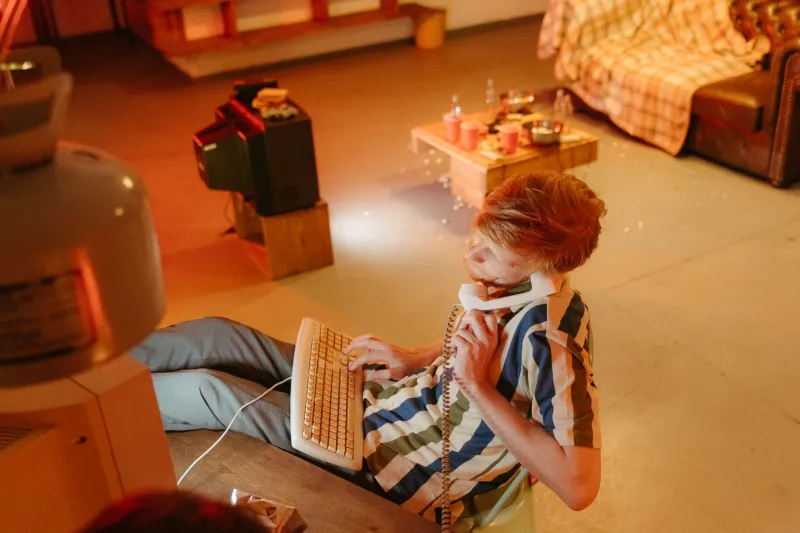
At some point in the last fifteen years, the phone call quietly became awkward. Not the phone itself — we carry it everywhere, check it constantly, sleep next to it like a trusted companion. Just the call part. The actual act of dialing someone, hearing it ring, and speaking words out loud into the air while another person listens in real time.
That used to be completely normal. Now, for a significant portion of Americans under forty, it feels vaguely aggressive.
When the Call Was the Plan
Cast your mind back to 1994. You want to make plans with a friend for the weekend. There is no text message. There is no group chat. There is no Instagram DM. There is a telephone, mounted to the kitchen wall, with a cord long enough to stretch into the hallway if you needed privacy.
You picked it up, you dialed, and you talked. Not a quick exchange of logistical fragments — an actual conversation. You figured out the plan in real time, negotiated the details, caught up on whatever had happened since you last spoke, and hung up fifteen minutes later with a clear understanding of where you were going and when.
The process required something that feels almost countercultural today: full presence. You couldn't be half-listening while scrolling. You couldn't craft your response while the other person was still talking. You had to be there, in the conversation, reacting in real time to a voice that carried tone, hesitation, humor, and feeling in ways that no text ever could.
The Texture of a Voice
This is the thing that text-based communication genuinely cannot replicate, no matter how many emoji you add to the end of a sentence.
A voice tells you things the words don't. It tells you whether your friend is actually fine or just saying they're fine. It tells you whether the apology is genuine or performative. It tells you whether the excitement is real or polite. Human beings evolved over hundreds of thousands of years to read vocal cues — the slight crack, the pause before answering, the shift in pitch — and those cues carry enormous amounts of information that simply vanish in a text thread.
Psychologists have documented this gap extensively. A 2020 study published in the Journal of Experimental Psychology found that people consistently underestimated how well they communicated empathy over the phone compared to text, and overestimated how well text conveyed emotional nuance. In other words, we think our texts are clearer and warmer than they actually are.
The result is a cultural miscommunication problem hiding in plain sight. We're having more exchanges than ever — messages fly back and forth all day — but we're understanding each other less deeply.
How Conflict Changed When It Went Digital
Nothing reveals the cost of text-based communication more clearly than watching people try to resolve a disagreement through it.
In the era of phone calls, conflict had a natural rhythm. You called. You explained yourself. The other person responded. You heard their frustration, or their hurt, or their confusion, and your brain automatically adjusted — because that's what human beings do when they hear a voice. They respond to the whole person, not just the words.
Text-based conflict is different in almost every way. Messages get sent and then sit there, unread, accumulating meaning they were never meant to carry. A two-hour delay in responding becomes evidence of indifference. A short reply becomes evidence of anger. Tone is invented from nothing. Misunderstandings compound because there's no real-time correction mechanism — no chance to say wait, that came out wrong before the other person has already read it, reacted, and started composing a response to the version of you they imagined.
Therapists across the country have noted a significant uptick in couples and friends coming to them with conflicts that originated in or were badly escalated by text exchanges. The medium, designed for convenience, has become a surprisingly effective engine for misunderstanding.
The Phone Call as a Skill We're Losing
Here's something that would have been genuinely baffling to someone in 1988: phone anxiety is now a recognized and widespread phenomenon, particularly among younger Americans. A 2019 survey found that more than 75 percent of millennials experience anxiety before making a phone call — not just with strangers, but with friends and family.
This isn't a character flaw. It's a skill that atrophies when it isn't practiced. Real-time conversation requires a kind of cognitive readiness that text does not — you have to think on your feet, manage silence, respond to things you didn't anticipate, and hold the thread of a conversation without the ability to edit yourself before you speak.
When you stop doing that regularly, it gets harder. The voice feels exposed. The silence feels threatening. The lack of a backspace button feels terrifying.
A generation that grew up communicating primarily through text has simply had less practice with the vulnerability of being heard — unedited, in real time, by someone who knows you.
Something Worth Recovering
None of this is an argument against texting. Texts are fast, efficient, and genuinely useful for a hundred daily tasks. The world is not going back to wall-mounted phones with tangled cords.
But there's something worth being deliberate about here. The friend you haven't spoken to in months — not texted, actually spoken to — is a friendship running on fumes. The apology you've been composing in your head as a text might land completely differently as a phone call. The plan that's been bouncing around in a group chat for three weeks might get resolved in a four-minute conversation.
The call isn't dead. It's just waiting for you to remember why it mattered.