When Knowledge Required a Journey: The Lost Art of Information Hunting in America
The Sacred Ritual of the Reference Desk
Walk into any public library today, and you'll find a lonely reference desk staffed by perhaps one librarian helping someone figure out how to print from a computer. But rewind to 1985, and that same desk was command central for an entire community's intellectual life.
Back then, librarians weren't just book organizers—they were information detectives, master navigators of complex filing systems, and the human Google before Google existed. Need to know the population of Des Moines in 1962? You didn't type it into a search bar. You approached the reference desk with the reverence of someone seeking an audience with an oracle.
 Photo: Des Moines, via static.vecteezy.com
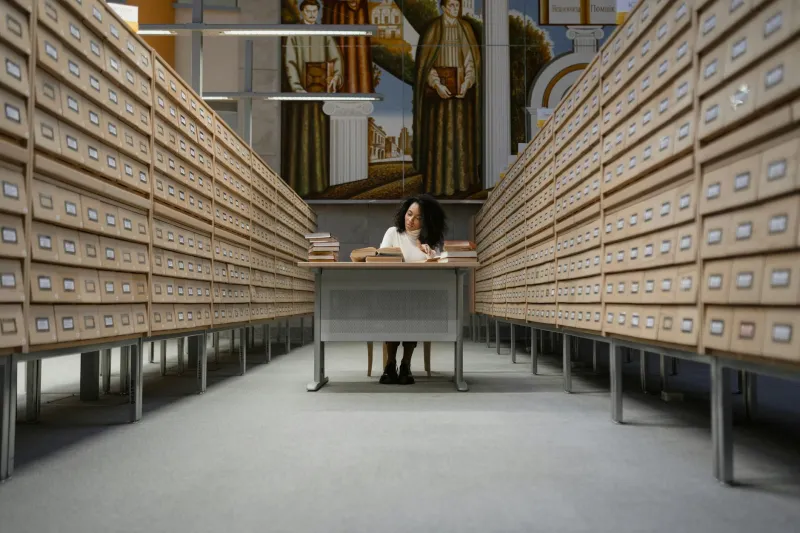
The librarian would disappear into the stacks, returning with an armload of almanacs, census reports, and regional directories. Sometimes they'd send you on a quest to the microfiche machine, where you'd spend the next hour scrolling through tiny newspaper images that made your eyes water. Other times, they'd direct you to the card catalog—that massive wooden cabinet that held the secrets to everything the library owned.
The Card Catalog: America's Original Search Engine
The card catalog wasn't just furniture—it was a masterpiece of analog organization that required actual skill to use effectively. Each drawer contained hundreds of index cards, meticulously typed and filed according to the Dewey Decimal System. Finding what you needed meant understanding how librarians thought, how they categorized knowledge, and how to think creatively about subject headings.
Looking for information about the Civil War? You couldn't just type "Civil War facts." You had to know to look under "United States—History—Civil War, 1861-1865" or maybe "Confederate States of America" or perhaps "Slavery—United States." Each search was a puzzle that taught you to think systematically about how knowledge connects.
Kids today can't imagine the satisfaction of finally locating the perfect source after twenty minutes of strategic drawer-pulling. That moment when you found exactly what you needed felt like striking gold, because in a very real sense, it was.
The Encyclopedia Expedition
Every middle-class American home had them: the 24-volume encyclopedia set that cost as much as a used car and took up an entire bookshelf. Encyclopedia Britannica, World Book, Funk & Wagnalls—these weren't just reference books, they were family investments in knowledge.
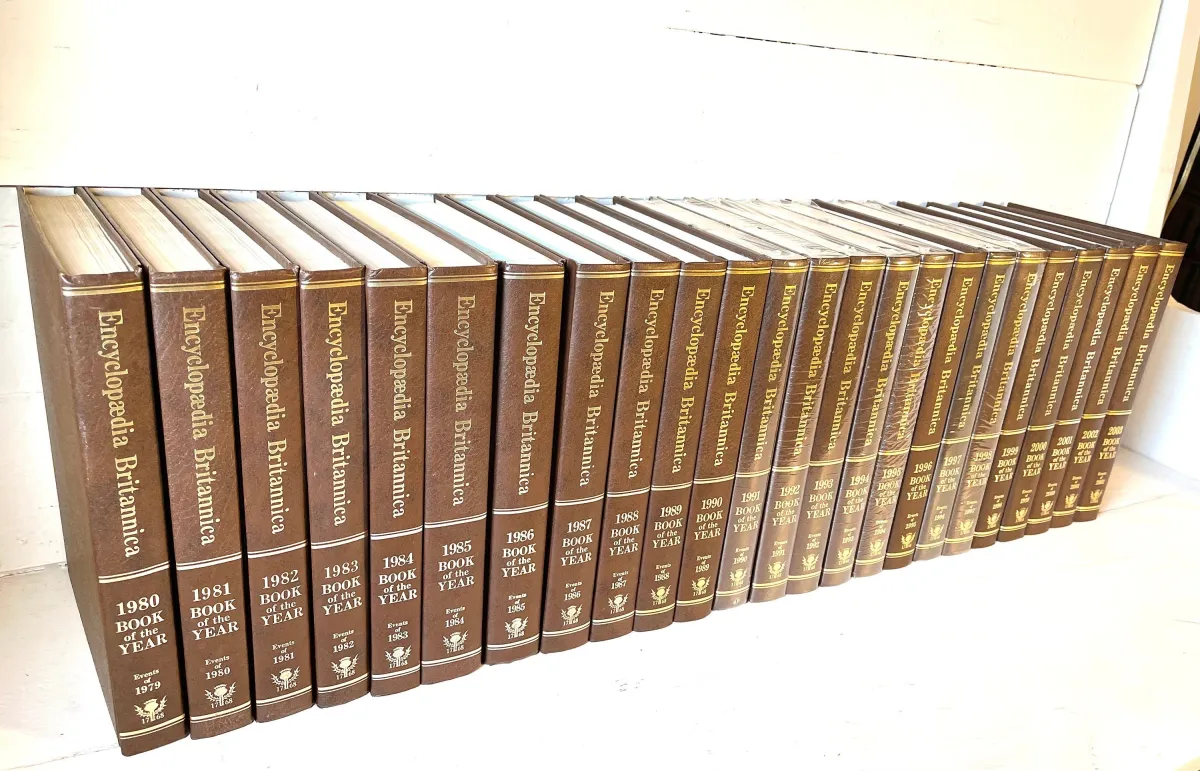 Photo: Encyclopedia Britannica, via i.etsystatic.com
When your kid had a report due on dolphins, you didn't Google "dolphin facts for kids." You pulled out Volume D, flipped to the dolphin entry, and discovered a 3,000-word essay written by an actual marine biologist. The information was authoritative, peer-reviewed, and came with a bibliography that could launch a dozen more research adventures.
But here's what made it special: the encyclopedia was a gateway drug to deeper learning. That dolphin article would mention echolocation, which would send you to Volume E. Echolocation would reference sonar technology, launching you toward Volume S. Before you knew it, you'd spent three hours traveling through interconnected knowledge, learning things you never intended to discover.
The Interlibrary Loan: When Books Took Road Trips
Need a book your local library didn't have? In 1980, that meant filling out an interlibrary loan request and waiting three to six weeks for your book to arrive via mail from some library in another state. The anticipation was genuine—you'd check with the librarian every few days, hoping your literary treasure had finally completed its journey.
This system taught Americans something we've completely lost: the ability to plan ahead for our intellectual curiosity. You couldn't satisfy every question immediately, so you learned to batch your research, to think strategically about what you really needed to know, and to appreciate information when it finally arrived.
The Microfiche Machine: Time Travel in a Basement
For historical research, nothing compared to the microfiche machine—that clunky contraption that looked like a cross between a microscope and a television. Newspapers, magazines, and government documents from decades past were photographed onto tiny film squares and filed in metal drawers.
Using microfiche was like being a detective in a noir film. You'd slide the film into the machine, adjust the focus, and slowly scroll through page after page of history. Want to read how newspapers covered Pearl Harbor? You'd spend an afternoon hunched over the machine, manually advancing through December 1941 editions of The New York Times, feeling like you were traveling back in time.
The physical effort required made every discovery feel earned. When you finally found that perfect quote or that crucial piece of evidence, you'd carefully advance the film to position it just right, then feed quarters into the attached printer to create a slightly fuzzy photocopy that you'd treasure like a archaeological artifact.
What We Gained and Lost
Today's instant access to information has democratized knowledge in ways our parents couldn't have imagined. Any question, no matter how obscure, can be answered in seconds. But we've traded something precious in the process.
The old system taught patience, research skills, and the ability to think systematically about information. It built relationships between community members and librarians. It made knowledge feel valuable precisely because it required effort to obtain.
Most importantly, it encouraged deep learning over quick answers. When finding information took time, you made that time count. You read thoroughly, took notes carefully, and often discovered fascinating tangents that enriched your understanding in unexpected ways.
The internet gave us the world's information at our fingertips, but it also gave us the expectation that every question should have an immediate answer. We gained efficiency and lost the contemplative journey that once made learning feel like an adventure worth taking.