Yellow Pages and Lucky Guesses: The Forgotten Art of Finding Things Out on Your Own
There was a particular Thursday afternoon feeling that doesn't exist anymore. You needed to know something — a business's hours, the capital of a country, the name of a medication side effect — and you had to actually work for it. You'd flip through the Yellow Pages, or drive to the library, or call a friend who seemed like they might know. Sometimes you found the answer. Sometimes you found something better.
That experience is gone. In its place is a search bar that returns 847,000 results in 0.43 seconds, most of them optimized to appear first rather than to be most useful. We gained speed. We lost something harder to name.
The Infrastructure of Not Knowing
Before the internet became a household fixture in the late 1990s, Americans operated within a rich, decentralized ecosystem of information sources. Each one had its own logic, its own limitations, and its own unexpected rewards.
The phone book was the most democratic. Delivered free to every household, the White Pages listed residents alphabetically while the Yellow Pages organized businesses by category. To find a plumber, you flipped to "Plumbing" and scanned a column of names, addresses, and quarter-page ads. The process forced you to notice competitors, compare prices printed in the ad, and make a judgment call based on very limited information. You developed instincts.
The library was the heavyweight. Reference librarians — and this is something worth saying clearly — were among the most useful professionals in any American town. They knew not just where information lived, but how to triangulate between sources, how to distinguish reliable from unreliable, and how to help you ask the right question when you'd walked in asking the wrong one. A good reference librarian could redirect an entire line of inquiry in three minutes.
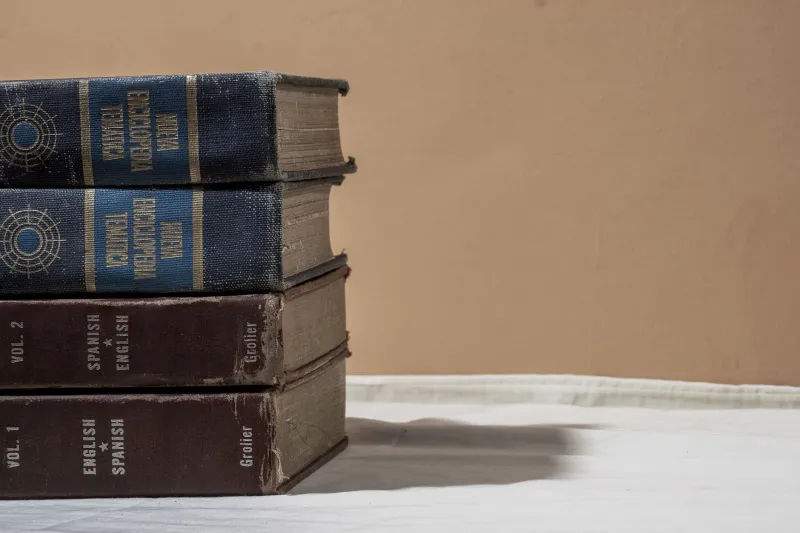
Encyclopedias sat in living rooms and school libraries like cultural monuments. The World Book. Britannica. Families invested in them the way they invested in furniture — with the expectation of long use. A child doing homework in 1978 might open a volume looking for information about the American Revolution and stumble across a detailed entry on the American bison, then read that too, because it was right there and curiosity doesn't stop at the assigned topic.
That accidental discovery — the serendipitous detour — was a feature, not a flaw.
The Expertise Economy
When you couldn't find something in print, you asked a person. And asking a person meant something different than it does today.
The pharmacist behind the counter knew your prescriptions and would talk to you about interactions without charging a consultation fee. The hardware store owner — who actually knew hardware — could diagnose your plumbing problem from a description and tell you exactly which fitting you needed. The travel agent didn't just book your flight; she'd been to Cancún twice and knew which hotels were actually on the beach versus which ones just said they were.
Expertise was geographically distributed and personally accessible. You knew who in your community to call for which kind of problem. That network was built over years and maintained through repeated, face-to-face interaction. It was inefficient by today's standards. It was also deeply reliable in ways that a five-star Yelp review has never fully replicated.
Phone calls to strangers were normal and expected. You'd call a business to ask a question, and a human being would answer and give you a real answer. Calling a government office to ask about a regulation would connect you to an actual clerk who might put you on hold for ten minutes but would eventually come back with the information. The friction was real. So was the accountability.
What the Algorithm Replaced
The internet's arrival didn't just speed up information retrieval — it restructured which information Americans encounter at all.
Search algorithms filter results based on engagement patterns, advertising relationships, geographic location, and your own previous search history. This is presented as a feature: personalized results, relevant content, things you'll find useful. And often it is useful. But it also means that what you see is shaped by what you've already seen, creating a feedback loop that narrows rather than broadens.
The serendipitous encyclopedia detour has been replaced by the algorithmic rabbit hole — which sounds similar but operates very differently. One was random. The other is optimized. You end up in unexpected places online, but those unexpected places were selected for you by a system that knows your age, location, device, and click history. It's curated surprise, which is a contradiction in terms.
The reference librarian has been partially replaced by search, but also by a culture that treats "I'll just Google it" as the end of the inquiry rather than the beginning. The art of asking a good question — of knowing how to frame a search, evaluate a source, and triangulate between competing claims — is now a specialized skill rather than a common one. Information literacy, once built into the process of finding anything, has to be explicitly taught.
The Speed Tax
There's a cost embedded in instant answers that rarely gets discussed: the loss of productive uncertainty.
When you didn't know something immediately, you thought about it longer. You formed a hypothesis. You discussed it with someone else. You lived with the question for a while, and that residence — that sitting with not-knowing — often produced more durable understanding than a quick lookup would have. Memory researchers call this the "generation effect": information you work to retrieve is retained more strongly than information you passively receive.
The muscle of tolerating uncertainty, of sitting with a question, of following a thread through multiple sources before arriving at a conclusion — that muscle has atrophied. Not because people are lazier, but because the environment no longer requires it.
What We Kept, What We Didn't
None of this is an argument for going back. The internet has democratized access to information in ways that are genuinely revolutionary. A first-generation college student in rural Mississippi can now access the same medical research, legal precedents, and academic journals as a student at Harvard. That matters enormously.
But it's worth being honest about the tradeoffs. We traded serendipity for speed. We traded local expertise for global reach. We traded productive uncertainty for instant answers that are sometimes wrong and usually optimized for someone else's interests.
The Yellow Pages sat on a shelf in the kitchen, fat and dog-eared, full of businesses that had paid to be listed and nothing more. It was imperfect, incomplete, and often frustrating. It also didn't know your search history. It didn't build a profile. It didn't decide, based on your previous behavior, which plumber you were most likely to click on.
It just listed them alphabetically and let you figure it out.
There was something honest about that.