You Had to Mean It Before You Dialed: The Phone Call That Cost You Something
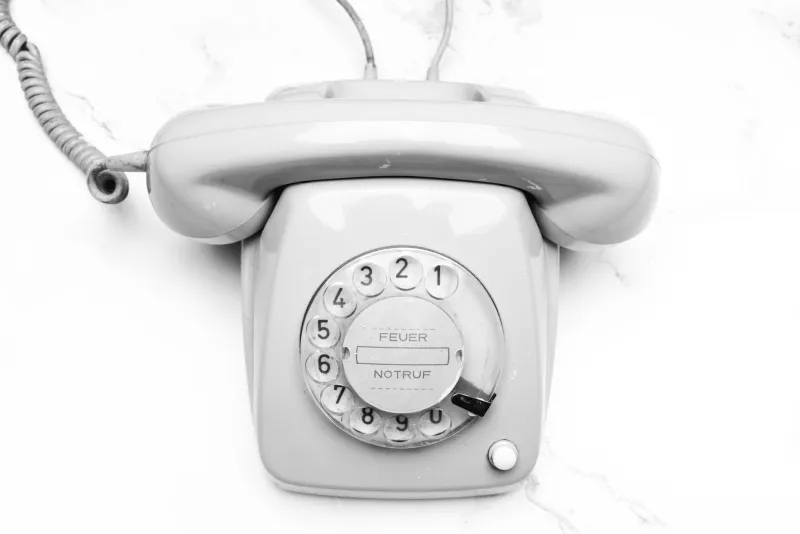
Picture this: it's 1974, and you need to call your cousin in Phoenix. You're in Cleveland. You walk to the kitchen phone — the one bolted to the wall with a cord that barely reaches the table — pick up the receiver, and start dialing. Slowly. One finger in the hole, rotate, wait, next digit. Nine digits total. If you mess up on the eighth, you start over.
By the time the line connects, you've already committed. You had a reason to make this call. You weren't bored. You weren't lonely in a vague, scrollable kind of way. You had something to say.
That world is gone. And most of us have no idea what we lost when it left.
The Rotary Dial Was a Filter
It sounds strange to say that slow technology made for better communication, but hear it out. The rotary phone — and before that, the operator-assisted call — introduced what designers today would call friction. You couldn't act impulsively. The technology slowed you down just enough to make you think about whether the call was worth making.
Long-distance calls cost real money. In the 1960s and '70s, calling someone in another state could run you several dollars for just a few minutes — the equivalent of ten or twenty dollars today. Families had actual conversations about who was worth calling long-distance. Sunday evening was a common window because rates dropped. You planned for it.
Even local calls carried a kind of weight. Party lines — where multiple households shared a single telephone line — were still common in rural America well into the 1950s. You couldn't just pick up and gossip. Someone else might already be on the line. Someone else might be listening.
All of this created a culture of intentional communication. You didn't call to fill silence. You called because something had happened, because you had news, because you genuinely needed to connect. The message was shaped before it was delivered.
The Phone Booth and the Pause Before the Call
There's another piece of this that gets overlooked: the phone booth. If you were out in the world and needed to make a call, you had to find one, have change in your pocket, and stand in a glass box on a street corner where anyone could walk by. That was your only option.
That setup enforced a kind of social filter. You didn't call people from restaurants, movie theaters, or the middle of a conversation with someone else. The physical act of stepping away, finding a booth, feeding in coins — it told the person on the other end that you'd made an effort. That effort meant something.
Compare that to today. A text message takes three seconds. A voice call is one tap. You can reach almost anyone, anywhere, anytime, for free, with no preparation. The barrier to contact has been reduced to essentially zero.
What Happened When the Friction Disappeared
When unlimited calling arrived in the late 1990s and early 2000s, followed quickly by smartphones and then messaging apps, something shifted in how Americans related to each other through communication.
First, volume exploded. The average American now sends and receives dozens of texts daily and has access to messaging platforms, social media DMs, email, video calls, and voice calls — all simultaneously, all free. The sheer quantity of contact went up. But something about the quality quietly drifted.
Researchers and psychologists have noted a paradox in modern communication: we are more reachable than at any point in human history, yet loneliness rates in the US have climbed sharply over the past two decades. A 2023 report from the US Surgeon General described loneliness as a public health epidemic. More messages, more calls, more pings — and yet more people feeling disconnected.
Part of this might come down to what frictionless contact does to the meaning of the gesture. When a call costs nothing to make, it signals nothing about the caller's investment. A quick text can be sent while doing three other things. It arrives, it's read, it disappears into a scroll. The very ease of the contact strips it of weight.
The Attention Span That Never Got to Develop
There's another angle here that has nothing to do with relationships and everything to do with the individual. The old telephone system forced a kind of mental preparation. You thought about what you were going to say before you picked up the phone. You organized your thoughts. You rehearsed the conversation, at least loosely.
Now, most communication happens in real time, unedited, reactive. We respond before we've fully processed. We send messages we haven't thought through and then send corrections, clarifications, or apologies immediately after. The loop between thought and transmission has collapsed.
This isn't just a communication issue. It's a cognitive one. The habit of pausing before speaking — of considering your words before committing them — was quietly reinforced by the technology of the era. The rotary dial, the coin slot, the long-distance rate: they were all, in their own way, asking you to slow down.
The Thing We Call Progress
None of this is an argument for going back. Instant communication has connected families across continents, saved lives in emergencies, and given people access to support networks that wouldn't have existed otherwise. The benefits are real and significant.
But it's worth sitting with the idea that some of what we called limitations were actually doing useful work. The friction of the old telephone world created space between impulse and action. It made communication a deliberate act. It gave words a kind of weight that came from the effort behind them.
The rotary dial didn't make you a better communicator by accident. It made you think before you opened your mouth. And somewhere in the decades since, that pause got dialed out of existence.